

By Jesus Chavez
In 2005, design engineer Ryan Thurston moved with his high-tech employer Impinj to their new site in Fremont along the Lake Union shore. Over the last half-decade other high-tech companies, like satellites of Google and Adobe, have funneled into the two-city-block area of tidy brick office buildings, dropping onto the scenic stretch as if out of the sky.
It took about a month for Thurston to see his first suicide.

“It was a routine day, and I looked out the window and saw a guy face down with blood coming from his head,” Thurston said. “It was traumatic. Any time you see death, a body, it’s something you remember; but when it’s someone taking their own life, and you know it could have been prevented, that’s totally different.”
The new business community thriving under the shadow of the Aurora Bridge, officially the George Washington Memorial Bridge, had discovered its legacy of suicide jumpers — jarring indications of Seattle’s troubling public health issue.
“We knew nothing of the problem when we moved in there, but we found out it’d been going on for a long time,” said Thurston. “It was definitely traumatic. We had people that had to go home that day; we had grief counselors come out.”
Thurston, now studying business administration at MIT, led a local charge for suicide prevention and awareness not long after his first experience with suicide. He founded the nonprofit organization Seattle FRIENDS (Fremont Individuals and Employees Nonprofit to Decrease Suicides) that aggressively pushed for a government response to the issue of the Aurora Bridge. After months of research and speaking with representatives of the Washington State Department of Transportation and experts in the mental health field, the idea for a suicide-prevention barrier was formed.
|
“Suicide prevention efforts had been done in the past, but the efforts seemed to be failing … so a new approach needed to be tried — a more effective one,” said state Rep. Mary Lou Dickerson in an interview. “I don’t think there is a perfect solution, but given all the parameters they had to work with, I think they came up with a pretty good solution that will end up saving lives.” Beginning Nov. 14, steel frames could be seen jutting from the bridge’s sides, and each week it was encased further and further. The construction of the fencing is scheduled to be completed early 2011, and the total cost of the 8-foot-9-inch fence will run $4.6 million out of the WSDOT budget. It took years of investigating, attending committees and hearings and maneuvering through the contentious legislative process for Seattle FRIENDS to get that amount of funding. In the end, they successfully lobbied legislators like state Sens. Ed Murray and Jeanne Kohl-Welles. Dickerson was on the House Transportation Committee and took the lead to put the fence proposal in the transportation budget that Gov. Chris Gregoire signed in May 2009. “The state transportation department funds billions of dollars worth of infrastructure changes for the state, so a $5 million dollar project is not on their radar, even though it was very controversial at the time,” said Thurston. And there was controversy. Ellen Monrad, president of the Queen Anne Community Council, remembers well when the idea for the fence was first proposed. The QACC was asked for its opinion on putting up a suicide-prevention barrier, but a past incident with WSDOT precluded a cooperative attitude. Before the council was approached for its support of the fence proposal, it had had a proposal of its own. A council member’s teenage son was killed on the Aurora Bridge in a head-on collision, and the council passionately appealed to the state for the construction of a median barrier between the north- and southbound traffic on the bridge. “They said it couldn’t be done because you can’t put a single ounce more on that bridge, that engineering-wise it’s maxed out,” said Monrad. “We didn’t exactly buy that; we thought it was just an excuse.” And these suspicions were given credence not long after when WSDOT began making plans to build a very heavy fence on that same bridge. The difference, according to WSDOT, is the placement of the weight, which can be tolerated on the sides but not the center. “They never explained that to my satisfaction,” Monrad said. “But I’m not an engineer, and the member whose son was killed will never accept that explanation.” Concerns over the use of state funds, the fence’s efficacy in abating and addressing suicide, and landmark preservation also peppered the fence debate. But, according to Monrad and members of Seattle FRIENDS, the most vocal opposition came from those preoccupied with the aesthetics. Traveling on State Route 99 between Fremont and Queen Anne the view opens up, revealing picturesque downtown Seattle and Lake Union. “It’s a beautiful view, and that fence is going to cut it off,” Monrad said at the time Massana Construction began installing the steel girders. “The spacing of the steel stakes makes it become a solid wall when you drive down the Aurora Bridge. When it becomes more like a tunnel, more people will start complaining.” Many will tell you it wasn’t until Fremont was developed in the area underneath the bridge, and businesses like Adobe and Impinj had moved in, that the city and state took notice of the issue. The phenomenon of suicide deaths around the Aurora Bridge is long-standing — the first suicide from the Aurora Bridge occurred in January 1932, a month before it was finished being built. And long before the development of business offices along that stretch of Fremont’s shipping canal, the Queen Anne boat community suffered from suicide deaths at its doorsteps. “It really was not until the development of Adobe and the land under the bridge when people who were working in those buildings saw when people went over and landed in their parking lots,” said Kathleen Southwick, executive director of Crisis Clinic. “So that was really the impetus that pushed this into being a much more political issue.” But the issue of suicide is anything but political. It is, according to Southwick, a serious public health issue. Just from Jan. 1 to Nov. 30 of 2010, jumping from the Aurora Bridge resulted in three deaths, the last one in September by a 23-year-old Renton woman, according to the Seattle Police Department. It is, in fact, second only to the Golden Gate Bridge in the total number of recorded suicide attempts in the United States. Although Washington’s reputation for high suicide rates isn’t entirely accurate (In 2007, Washington had the 23rd highest suicide rate in the nation at 13.4, compared to the national average of 11.5. Alaska was No. 1 at 21.8), in King County between 1998 and 2007 there were more deaths by suicide than homicide and car accidents combined, according to the King County Medical Examiner’s Office. The Crisis Clinic’s crisis-intervention phone line handles between 80,000 and 90,000 calls a year, and of those approximately 6,000 are suicide calls. In December of 2006, about the time Seattle FRIENDS started searching for their own solution, six phones were installed on the Aurora Bridge that call 911 or the Crisis Clinic. This was the measured response of the Seattle Department of Transportation to the disturbingly high count of suicides in the preceding years, which peaked in 2005. One of these suicides was by 15-year-old Maren DeVries in May 2006, the youngest recorded suicide from the bridge, according to friend Rachel Izzo. Izzo, a cheerful, athletic Seattle University junior, played soccer with DeVries when she was a sophomore in high school. It was a year later at a memorial for DeVries near the spot of her death that she was approached by Seattle FRIENDS to join the suicide-prevention cause. Eager to help, she quickly joined. “Suicide in general is awful; it’s hard to deal with … but when it’s public, like off a bridge, it’s different because it deeply affects more than just the family and friends,” Izzo said. “Even if it’s just five lives that are lost here every year, those five lives affect everyone in this community.” Wallingford resident and teacher Scobie Puchtler lives in walking distance of the bridge, and he’s intimately familiar with suicide. His father shot himself two and a half years ago, and he is currently a member of Crisis Clinic’s Survivors of Suicide support group. “[The fence] makes a ton of sense to me — it’s important for so many reasons,” Puchtler said. “But it’s important to me as a last step because when you think about suicide prevention, that is the last minute in a process that could have started years and years before.” |
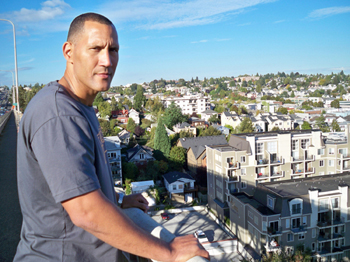 Heath Rainwater, a firefighter, pastor, and organizer of the Take Back the Bridge Project, stands at the spot where he watched a man jump to his death. “I’m underneath the bridge as a firefighter, even though I’m a pastor, and I’m looking at a young man who is on top of the bridge. I couldn’t hear him but you could see that he was extremely distraught. He was going back and forth, and when the police negotiators were talking to him, whatever they were saying to him wasn’t getting through to him. I felt grossly out of position that day and just really wished that I could be up there and have an opportunity to speak some words of love, hope and truth to get him to reconsider and know that there is some hope.” (Photo: Jesus Chavez) 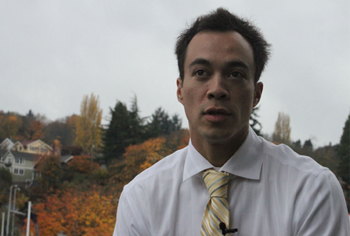 Ryan Thurston, founder of Seattle FRIENDS, sits underneath the Aurora Bridge near his former employer Impinj. He talked about witnessing suicides from his work. “First one I saw, it was a routine day, I looked out the window and saw a guy face down with blood coming from his head. I thought, ‘What happened here, this doesn’t make sense.’ I thought he might have slipped and fell, but when I looked up on the bridge I saw his truck with the door open and people up on the bridge pointing down. It was pretty traumatic.” (Photo: Yuzheng Zhuang) 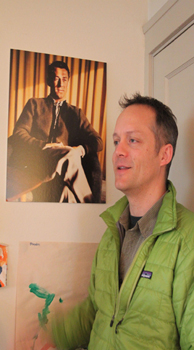 Scobie Putchler, a Wallingford resident and member of Crisis Clinic’s Survivors of Suicide support group, stands by a photograph of his father and remembers him learning to snowboard at the age of 60. He spoke earlier about his father’s suicide. “It’s unbelievably traumatic; it was incredibly violent; it was devastating … It starts with shock. I spent hours there waiting for the police to do their job and the coroner to come and collect his body. We were forced to stay outside. It was rainy and cold and somehow that actually felt good. It felt right somehow to be out in the cold rain. Anything else would have seemed really weird. From there everything falls apart for awhile. The effects keep coming in waves, and you don’t know what they’re going to be.” (Photo: Yuzheng Zhuang) 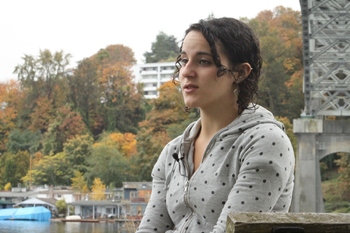 Rachel Izzo, a Seattle University junior and member of Seattle FRIENDS, sits below the Aurora Bridge, where her friend killed herself as a high school sophomore. She recalled how she was told before a soccer game about her friend’s suicide. “There was about three of us there — the coach, his daughter, and someone else — and he looked kind of upset about something … He sat us all down and started pacing back and forth and didn’t know how to tell us. He said that a girl had jumped off the bridge yesterday morning. I was thinking why is he telling us this, and then he said it was our teammate. We canceled our soccer game; we were all really upset. We were all crying.” (Photo: Yuzheng Zhuang) 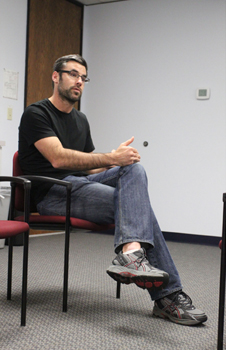 Gavin Turner is a volunteer coordinator at Crisis Line, which answers more than 80,000 crisis calls a year. “By definition a crisis situation is one where people are feeling escalated. They are in an emotionally heightened situation; they feel that they’re alone; they feel this kind of tunnel vision; they feel like they’re out of options. They need help, and a more objective, empathetic ear to help them sort of move them through that really muddy, cloudy situation they are currently in.” (Photo: Yuzheng Zhuang) |
Michael Reading, director of crisis services at Crisis Clinic, likewise cautions against too much satisfaction with the fence. The fence will reduce, if not eliminate, suicide jumpers from one Seattle area, but the larger issue of suicide will persist, and the personal and social issues that contribute to suicidal acts will continue to fester.
“It’s that intervention in that immediate moment that’s going to save their life for that moment, but that’s not to say they won’t go complete suicide the next day, the next week, or the next year,” Reading said. “Suicide is a problem we need to address seriously in our mental health system … People are in pain in this world and our community, and they need help.”
Fenced In: The journey to prevent Aurora Bridge suicides from Sam Han on Vimeo.
This story was produced by students in the University of Washington’s Entrepreneurial Journalism course.

Read previous stories from the Student Projects:
Crime Prevention Officers Face Budget Axe, The Homeless Neighbor, Buckaroo Tavern Pours Last Drink, Recession Sparks Entrepreneurialism in Ballard, The Missing Link and Lights Out, Computer On
Learn more about the nonprofit Common Language Project