

After responding to complaints from neighbors about the late-night noise, Aurora Bridge construction crews have begun a new work schedule.
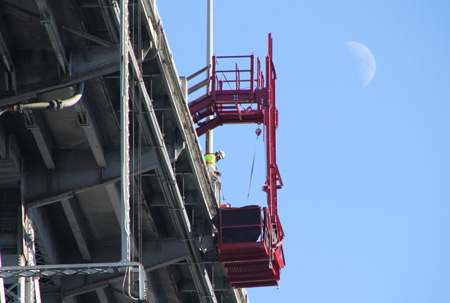
The first of four Sunday shifts, WSDOT crews resumed using the loud tool called the “Rivet Buster” today to build the suicide fence along the bridge. But unlike last time, workers will avoid the overnight hours.
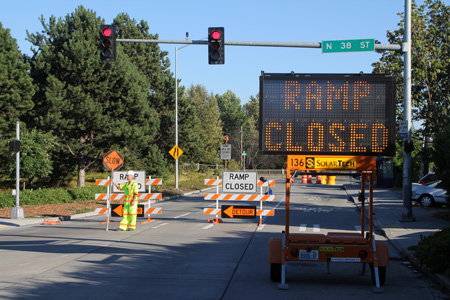
Until midnight tonight (Sunday), two of three southbound lanes on the bridge and the southbound Fremont Way N. on-ramp are closed to traffic.
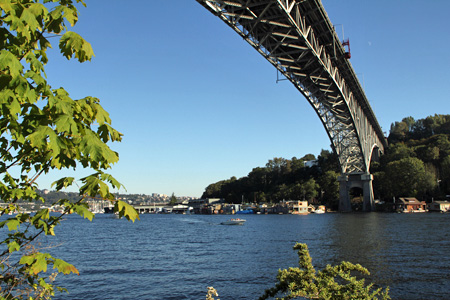
“WSDOT engineers looked at weekday and weekend traffic volumes and determined that four 16-hour Sunday closures would allow crews to get the work done with the lowest overall noise and traffic effects,” explains WSDOT in a press release. “Four straight Sunday closures are critical to completing the fence project by the end of the year.”
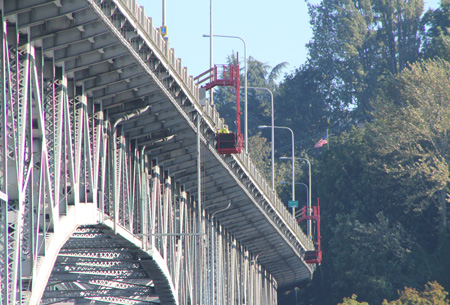
Drivers can expect additional Sunday closures on Aug. 22 (northbound), Aug. 29 (half day each northbound and southbound), and Sept. 5 (northbound).


21 responses so far ↓
1 Iron City Mike // Aug 16, 2010 at 2:38 pm
Remind me what the point of this is again? If someone wants to commit suicide, they will find another way. This is not going to save any lives, just waste dollars and uglify the bridge.
2 hey there // Aug 16, 2010 at 4:10 pm
Here is your reminder:
http://www.nytimes.com/2008/07/06/magazine/06suicide-t.html
Also they:
1. keep jumpers off the bridge
2. keep the people below safe from jumpers
3. keep first responders from having to respond
4. keep the city crews from cleaning up the horrific mess when they hit land
5. are being installed on suicide bridges all over the world
You’re welcome.
3 Iron City Mike // Aug 16, 2010 at 4:34 pm
Very interestingt article, thanks for posting.
4 Fremonster // Aug 16, 2010 at 10:58 pm
Every day a ride my bike home under the bridge. Every day I wonder: Will this be the day a body lands on me?
5 mike // Aug 16, 2010 at 11:22 pm
1. the suicide barrier does not keep jumpers off the bridge, they can still go on the bridge. it just makes jumping more difficult.
2. exactly how many people have been hit by jumpers? i believe the number is zero.
3. first responders will still have to respond to the other 200+ people who commit suicide by NOT jumping off the bridge annually, not to mention the 800+ that fail to kill themselves and require medical attention
4. again, not much different than the other 200+ suicides per year. GSWs are also quite horrendous.
5. that doesn’t mean they work at actually preventing suicide.
seriously, when will the US wake up and realize throwing lots of money at something stupid (suicide barrier) makes ZERO sense when an overwhelming number of suicides (and murders) are committed by GUNS.
fund access to mental health, not barriers.
6 Fremonster // Aug 16, 2010 at 11:27 pm
2. exactly how many people have been hit by jumpers? i believe the number is zero.
Which means I don’t want to be the first.
7 mike // Aug 16, 2010 at 11:41 pm
fremonster,
more people have been killed by dump trucks in this city than suicide jumpers.
please check your irrational fears at the door.
8 sdh // Aug 17, 2010 at 7:43 am
I agree with the irrational fears/waste of money comments.
And i heard the noise from the rivet machine on Sunday - no wonder people couldn’t sleep through it. I’m stunned WSDOT thought the overnight idea would ever work.
9 nprfool // Aug 17, 2010 at 9:43 am
Hi Mike,
There have been a number of near misses of pedestrians and drivers by jumpers, including children and teens, not to mention the property damage and emotional trauma of the unsuspecting passersby. Since half the bridge is over land, including major roads, the Burke-Gilman, several businesses, and a small park, this is a particularly nasty problem.
More importantly, there is a huge body of research going back 35 years that indicates if you remove the immediate method for suicide, you can significantly reduce the overall suicide rate. This is particularly true for jumpers, as this method is primarily used by an especially impulsive group who are suffering an acute episode. If they are prevented from jumping, most will never go on to make a second attempt (and yes, this has been studied and there are numbers to back this up).
Bridges that have installed barriers have been extensively studied, and the results clearly show that they work. They not only reduce suicides off the particularly bridge down to nearly zero, the overall rate of death by jumping in the surrounding area nearly always decreases as well.
If you are interested, I posted ten major, peer-reviewed studies on the subject here. There are more, but these are some of the seminal works to date:
http://www.fremontuniverse.com/2010/08/01/the-aurora-bridge-rivet-buster-cant-get-any-sleep-loud/#comments
I agree with you that increased funding for mental health would be a good thing. But these bridge barriers have been well studied, they are demonstrably effective, and are relatively cheap to implement. We can, and should, do both.
10 Fremontster // Aug 17, 2010 at 10:06 am
“more people have been killed by dump trucks in this city than suicide jumpers.”
Statistics or it didn’t happen.
11 mike // Aug 17, 2010 at 1:04 pm
fremonster:
bryce lewis, killed in sept. ‘07 by a dump truck
http://www.thestranger.com/seattle/Content?oid=322254
npr:
there have been a number of bikers hit by cars, do we fence in cars to protect bikers and pedestrians? the bridge doesn’t cross any major roads, 35th and 34th are not major thoroughfares.
the university of toronto just came out with a study showing that while adding a suicide barrier on the bloor street viaduct reduced jumps at that location, the city’s rate of suicides byjumping did NOT decrease.
also, we’re talking about a statistically insignificant portion of the number of people that kill themselves every year, jumpers are almost dead last.
the barriers aren’t effective enough to warrant the costs. the danger to society is almost zero. americans need to get over the stigma of suicide and provide assistance for those that need it, instead of building fences that help no one.
12 mike // Aug 17, 2010 at 1:05 pm
here’s the reuters write up on the UT study
http://www.reuters.com/article/idUSTRE6665PS20100707
13 Bergy // Aug 17, 2010 at 1:36 pm
Mike:
Dexter, Westlake and 34th ARE major thoroughfares
14 nprfool // Aug 17, 2010 at 2:10 pm
I am aware of the Bloor Street viaduct (Toronto) study, which was published last month in the British Medical Journal. The Bloor Street viaduct saw suicides at about a third the rate of the Aurora bridge prior to installing a barrier. The number of suicides off the viaduct did drop dramatically, but the overall regional rate did not. The news article is fine, but the link to the actual journal abstract is here: http://www.ncbi.nlm.nih.gov/pubmed/20605890
15 nprfool // Aug 17, 2010 at 2:11 pm
(continued)
The conjecture by the authors in the conclusion is that the lack of decrease in the regional numbers may be due to low suicide numbers in the first place, plus accessible and well established suicide sites nearby. Both the authors as well as the editors of BMJ (who published a side editorial on this article in the same issue of BMJ) are calling for further studies at this particular locale. Here is a link to the BMJ editorial that outlines the nuances of this particular study, and suggests areas for further research. Note that both the authors and the editors still conclude that that barriers are effective in many circumstances, but perhaps not all. http://www.bmj.com/cgi/content/full/341/jul06_1/c3054?view=long&pmid=20605891
16 nprfool // Aug 17, 2010 at 2:12 pm
(continued again)
One additional factor in the effectiveness of barriers is cultural. Certain cultures (not ours) place a lower stigma on suicides, and barriers have been less effective in such societies. Studies on bridges in Hong Kong, for example do not show as dramatic a decrease as they do elsewhere. This is NOT the case for Western ones, however.
Many other studies of significant suicide bridges have definitively shown that barriers are effective at reducing suicides both at the bridge site as well as regional - the Clifton bridge in England, the Grafton bridge in Auckland (which had the barrier removed then reinstalled), and the Duke Ellington Bridge in DC (the nearby Taft bridge with higher railings saw no increase). There are many more, if you want to do further research, but these are the most frequently studied and cited.
The specific circumstance of the Aurora bridge make it a good candidate for an effective barrier - it is a well known suicide draw, it has a significant area over land and populated areas, barriers have been effective in similar cultural regions, and there are no nearby similar structures that already attract a significant number of jumpers. I am aware that the I-5 Canal bridge is nearby, but it currently is blocked off to pedestrians and is not a well known suicide draw (about 1 per year). The other fact to note is that suicides from the Space Needle dropped off dramatically after its barriers were put into place.
This barrier is a very good thing. The Aurora bridge is the second most common bridge for suicides in the US. Half of it is located over land, and people and property below are at great risk, not to mention the cost of emergency responders. There may be other risk factors out there (cars vs autos as Mike suggested), but that does nothing to negate the effectiveness and low cost of this particular solution for this particular problem.
17 nprfool // Aug 17, 2010 at 2:13 pm
Sorry for the three part post - I wasn’t able to post it as one single post. Not sure why (perhaps the multiple links?)
18 mike // Aug 17, 2010 at 2:25 pm
let me put it another way…
the hideous fence costs 6,000,000+
you could staff both sides of the bridge, round the clock (3×8 hour shifts) for 33 years for the same cost (assuming 30k/year)
which do you think would have a more positive effect on our society? which do you think would actually have an effect on suicide rates, reaching out to those that need the help?
this is a ginormous, inefficient waste of taxpayer resources - a slap in the face to those contemplating suicide and in need of assistance and taxpayers alike.
19 nprfool // Aug 17, 2010 at 2:30 pm
That is what is done on the Golden Gate, and it has had very little impact on the suicides off the bridge.
Mike, I get it, you don’t care for this. The studies say otherwise.
20 Fremontster // Aug 17, 2010 at 2:51 pm
Mike, seems like you have a lot of free time. How about you take the first shift?
21 WildernessBarbie // Aug 18, 2010 at 9:57 pm
I used to think that this was a big waste of money in an economy that could really use it elsewhere… why spend money trying to get people to not do what they seem determined to do anyway?
Then I talked to someone who worked under the bridge, and she said someone attempted it at least once a week (unverified). One co-worker had a body fall right in front of his car, another right in front of his bike. She’s seen and heard someone fall past her window. The impact (pun not intended) that this has on the people who live and work in that area shouldn’t be discounted. They have to work there and see the spot where someone was scraped up off of every day.
Not to mention the many, many thousands of dollars required to respond to a potential jumper. There’s one on it right now and the cops, Harbor Patrol, negotiators, medics and more are all out there holding up traffic and trying to help her. Not the same response she’d get if she threatened to swallow a bottle of pills.
While it does seem like a poor use of funds that would better be spent on schools or cops, I now understand and sympathize with the people who have to deal with the potentiality of a jumper and how difficult that could be.
Leave a Comment